Why pharmacy dermocosmetics is the perfect category for a neutral AI decision layer
Pharmacy dermocosmetics is one of the hardest beauty categories to sell well online. It is also where a neutral AI decision layer delivers the most value. These two facts are connected, and the connection is the whole point.
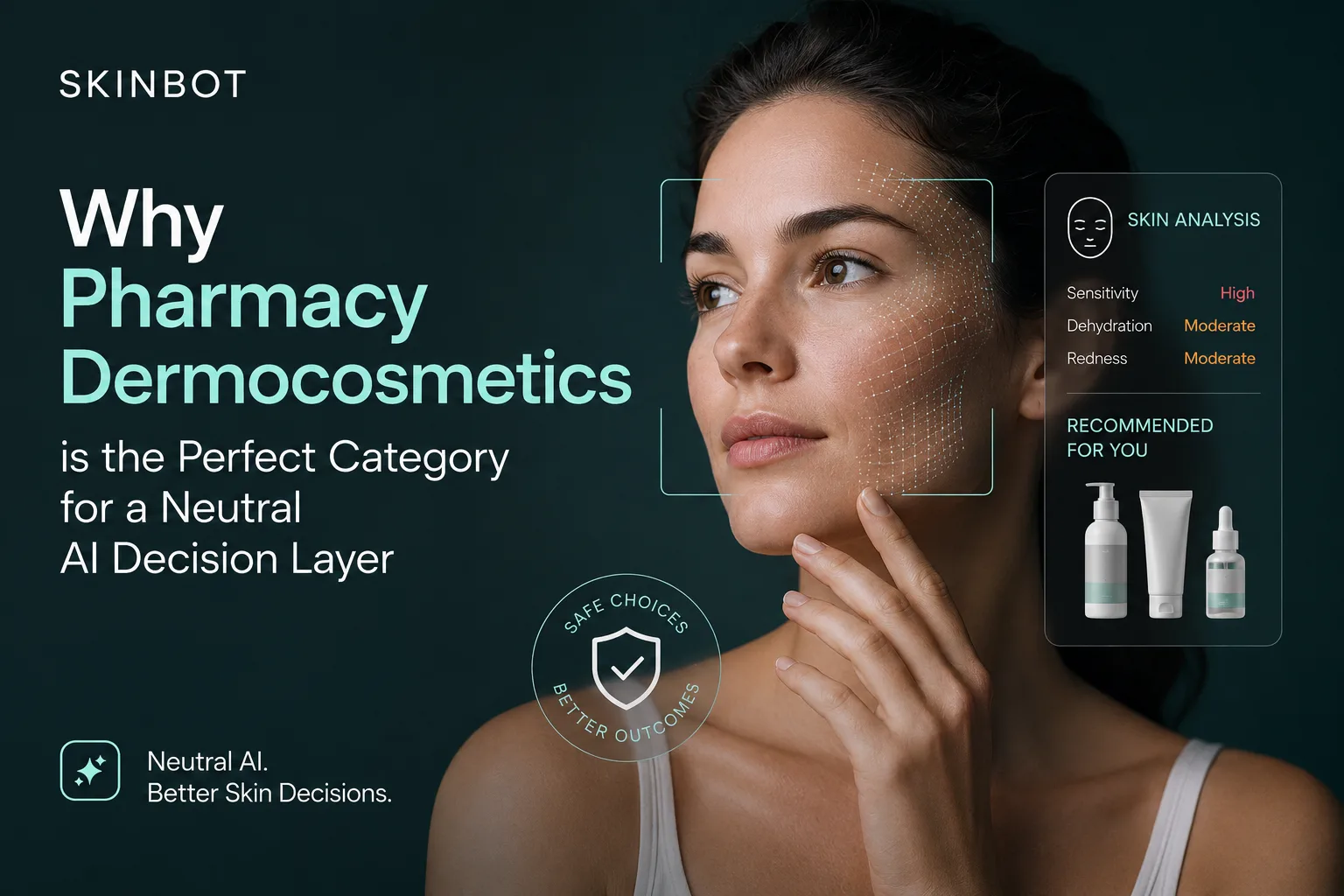
A category built on consultation
Few beauty categories have depended as heavily on professional guidance as pharmacy dermocosmetics. For decades, the safety filter was the pharmacist behind the counter: someone who understood sensitivity, reactivity, and ingredient compatibility, and who knew how to say the category’s defining sentence: “this one is not for you.”
Then sales moved online, and the filter disappeared. A five-button quiz took its place. The trust mechanics that built the category did not survive the transition, while the cost of error stayed exactly the same.
Three requirements that forgive nothing
The cost of error is physical. Dermocosmetics shoppers often arrive with sensitive, reactive or atopy-prone skin, visible redness, and a history of products that did not work for them. A wrong active on reactive skin is not a bad review - it is a reaction. Selection in this category must know how to exclude: not “here are ten options” but “here is what fits you, and here is what does not.” In SKINBOT, user constraints - sensitivity level, allergies, the eye area - are not an extra filter but part of the logic behind every recommendation.
The words are regulated. A pharmacy brand cannot afford a single medical claim inside a recommendation - that is regulatory risk in every session. This is why SKINBOT includes a controlled language layer designed to prevent diagnostic wording and unsupported medical claims from appearing in recommendations. That is not a limitation of capability - it is brand protection running in every response, without requiring manual legal review of every individual session.
The data is sensitive. Skin condition, concerns, photos - not something people want stored in a database. SKINBOT is designed around data minimization: it does not create persistent consumer profiles, and session inputs are not retained beyond the processing required to produce the recommendation. This reduces the amount of personal data the retailer has to collect, retain, and secure by design.
A field note
From live deployments: image-only skin analysis becomes less reliable when the customer is wearing makeup, which is how many real shoppers arrive. A session dialog works every time: the conversation establishes the decision context, and the image, when used, refines it rather than carrying the entire recommendation. Robustness to real conditions is an underrated property, right up until you start measuring conversion.
Trust as a mechanism
What defines this category is trust, and that trust has a specific structure. A dermocosmetics buyer does not believe “buy this.” They believe an explanation: why this exact product, for this exact skin type, with these exact constraints.
Here it is worth defining neutrality precisely, because it does not require an unlimited catalog. Neutrality means the system has no incentive to push a particular SKU within the available assortment - and can conclude that a product, an active, or an entire routine is unsuitable. Catalog-bounded, but decision-neutral. Even inside a single brand’s lineup, this reproduces the mechanism the category was built on at the pharmacy counter: an expert with no reason to mislead.
Pharmacy dermocosmetics was built on guided decisions. Online, that guidance disappeared while the consequences of a poor choice remained. A neutral AI decision layer brings the missing expertise back - not to one counter, but to every session.
Originally published on Substack: katyashalel.substack.com